Now, before we go to the next verses, we need to look at the meaning of some words in Arabic language:
We explained before the meaning of Nutfah as a little water or liquid of mixture which could be understood – depending on the context it is said in – as a primitive organism such as a cell if it come in verses related to the creation of life from clay, and as the sperm or fertilized egg if it comes in verses related to the creation in the womb.
Alakah in Arabic means something hanged on another, i.e., two or more things cling together, one to the other. This indicate that Al Nutfah, the one single life form, the cell, is now hanged with another cell, or with many other cells, so Al 3lakah is a multi-cells organism, the multicellular [which appeared 2.5 billion years ago].
It has become noticeable that the first periods of the embryo development in the womb, follow similar stages as the creation of life from the first cell. That is why we find that the early interpreters found in the progress of the embryos the meanings of the Qur’anic verses which also related to the creation of life from the first cell.
Now, we need to review the Quranic verses to further understand this point:
If we look on the following verse:
{ .. هُوَ أَعْلَمُ بِكُمْ إِذْ أَنشَأَكُم مِّنَ الْأَرْضِ وَإِذْ أَنتُمْ أَجِنَّةٌ فِي بُطُونِ أُمَّهَاتِكُمْ ..} النجم 32
{…..He knows about you, when He created you from the earth and when you were embryos in the wombs of your mother’s…..} Chapter 53:32
In this verse, we find the reference to two different phases of human creation, the first is the creation of the species from the first cell which emerged from the elements of the earth. The second is the development of embryos in the wombs of the mothers.
The distinction between the two is clear in this verse. The other verses related to human creation, each of them refers to one of these two phases, and some may be referring to both. For this we have to be careful when studying these verses to determine which creation the verse is referring to, especially as we know that the stages of the growth in the womb, can be similar to some extent to the stages of life evolving from the first cell.
What makes this distinction need special attention, that we assumed that in some verses, a text intended to refer to the creation of life from the first cell, was composed in a way, so that it allows itself to be understood as the development of the embryo in the womb, until the day that human knowledge advances to a level, that uncovers the concept of creation by evolution or by directed evolution, then people will be able to interpret the verse in light of such concept. And even at that time, the verse may still serve both interpretations.
What said above, is similar to the arrangement applied to the concept of Adam being created directly from clay, to allow such verses to be interpreted in earlier times, when human knowledge was still on the belief that Adam was created directly from dust, the same verses, when human knowledge advanced, became able to describe the emergence of life on Earth from the first cell.
This is how the verses were interpreted in previous times, most mentioning of creation from clay, were interpreted to mean the creation of Adam, and the others which showed progressing stages were understood to refer to the development of the embryo then the fetus in the womb. The text was designed to allow these periodic interim interpretation in order to agree and not to conflict with human knowledge at such early times, even when this knowledge was not correct or accurate. But today, as human knowledge advanced, the same text is able to disclose its intended meaning, which emerges from the interaction between the fixed text and the advancing human knowledge.
Now let us look at verses referring to the creation of the Humans species from dust and the developing of the embryo in the womb:
{إِنَّا خَلَقْنَا الْإِنْسَانَ مِنْ نُطْفَةٍ أَمْشَاجٍ نَبْتَلِيهِ فَجَعَلْنَاهُ سَمِيعًا بَصِيرًا(2)}
مشج (مقاييس اللغة) الميم والشين والجيم أصلٌ صحيح، وهو الخَلْط. ونُطفةٌ أمشاجٌ، وذلك اختلاط الماء والدّم
{We created man from Nutfat AmshaJ to try him [test him]; so We made him hearing and seeing [knowing]} Chapter 76:2
Amshaj (in Maqayees Al Loghah, Ibn Faris] “Mashaj is a mix”
{We created man from little liquid of a mixture [of elements] to try him [test him]; so We made him hearing and seeing [knowing]} Chapter 76:2
In this verse, the creation of the human species, from Al Nutfah is described here to be a liquid mixture of elements, it could be a living organism, cell, RNA, DNA. Or it could refer to the embryo resulting from the sperm and egg, the fertilized egg in case it is referring to the growth of the embryo in the womb. As is referred to in the following two verse:
{وَأَنَّهُ خَلَقَ الزَّوْجَيْنِ الذَّكَرَ وَالْأُنْثَى (45) مِنْ نُطْفَةٍ إِذَا تُمْنَى(46) وَأَنَّ عَلَيْهِ النَّشْأَةَ الْأُخْرَىٰ (47)}
{And that He created the pairs, the male and the female (45) From a Nutfah when emitted (46) And that [incumbent] upon Him is the next creation} Chapter 53
Here, the Nutfah is the sperm when emitted, or the egg when fertilized by the sperm.
Same in the following verse:
{ أَلَمْ يَكُ نُطْفَةً مِنْ مَنِيٍّ يُمْنَى (37) ثُمَّ كَانَ عَلَقَةً فَخَلَقَ فَسَوَّى (38) فَجَعَلَ مِنْهُ الزَّوْجَيْنِ الذَّكَرَ وَالْأُنْثَى (39)}
{Had he not been a Nutfah [little liquid] from semen emitted (37) Thereafter he was 3lakah [clinging clot], then (Allah) shaped and fashioned (him) (38) And made of him the pairs, the male and the female (39)} Chapter 75
These last two verses refers to the creation in the womb.
Now the following verse describe both the creation of human species followed by the creation in the womb:
{يَا أَيُّهَا النَّاسُ إِنْ كُنْتُمْ فِي رَيْبٍ مِنَ الْبَعْثِ فَإِنَّا خَلَقْنَاكُمْ مِنْ تُرَابٍ ثُمَّ مِنْ نُطْفَةٍ ثُمَّ مِنْ عَلَقَةٍ ثُمَّ مِنْ مُضْغَةٍ مُخَلَّقَةٍ وَغَيْرِ مُخَلَّقَةٍ لِنُبَيِّنَ لَكُمْ وَنُقِرُّ فِي الْأَرْحَامِ مَا نَشَاءُ إِلَى أَجَلٍ مُسَمًّى ثُمَّ نُخْرِجُكُمْ طِفْلًا ثُمَّ لِتَبْلُغُوا أَشُدَّكُمْ وَمِنْكُمْ مَنْ يُتَوَفَّى وَمِنْكُمْ مَنْ يُرَدُّ إِلَى أَرْذَلِ الْعُمُرِ لِكَيْلَا يَعْلَمَ مِنْ بَعْدِ عِلْمٍ شَيْئًا وَتَرَى الْأَرْضَ هَامِدَةً فَإِذَا أَنْزَلْنَا عَلَيْهَا الْمَاءَ اهْتَزَّتْ وَرَبَتْ وَأَنْبَتَتْ مِنْ كُلِّ زَوْجٍ بَهِيجٍ (5)} سورة 22
{People, if you are in doubt about the Resurrection, then [consider that] We have created you from dust, then from a Nutfah [little liquid], then from 3lakah [clinging organism], and then from a lump of tissues, continual creatable [evolving] and uncreatable [stopped evolving] – to show you. And We settle in the wombs whom We will for a specified term, then We bring you out as a child, and then you grow till you reach your full strength. And among you is he who will die, and among you he who will grow very old till he knows nothing, after knowing. And you see the earth barren, but when We send down upon it water, it quivers and swells and grows of every beautiful pair} Chapter 22:5
The first part, starts from the creation from dust, into Nutfah (Living single cell of a mixture of elements), then comes Al Alaka, the word alak in Arabic means something to hang and cling to another. Alaka, a noun, indicates many single cells clinging together, to form a Multicellular organism. [A multicellular organism is an organism that is made up of many cells clinging together]. Then from lump of tissues, a being which continue being created, and others stopped, here we find some continue to evolve while others stopped evolving (and also others died out and extinct). What was said was to show people who are in doubt about the Resurrection, that Allah created us in this life from dust, and He will create us again in the next life. Then the verse move to the wonders of the creation in the womb and our growing from a child to reach very old age when our cognitive abilities will deteriorate.
Now let us look at the following verse:
{ وَلَقَدْ خَلَقْنَا الْإِنسَانَ مِن سُلَالَةٍ مِّن طِينٍ (12) ثُمَّ جَعَلْنَاهُ نُطْفَةً فِي قَرَارٍ مَّكِينٍ (13) ثُمَّ خَلَقْنَا النُّطْفَةَ عَلَقَةً فَخَلَقْنَا الْعَلَقَةَ مُضْغَةً فَخَلَقْنَا الْمُضْغَةَ عِظَامًا فَكَسَوْنَا الْعِظَامَ لَحْمًا ثُمَّ أَنشَأْنَاهُ خَلْقًا آخَرَ ۚ فَتَبَارَكَ اللَّهُ أَحْسَنُ الْخَالِقِينَ (14)} سورة المؤمنون
{And We created Al Insan (genus Homo) from Sulalah [lineage – descent or extract] from clay (12) Thereafter We made him into Nutfah [seed-cell] in a strong resting-place (13) Thereafter We created al Nutfah into Alakah, then We created the Alakah into tissue, then We created the tissue into bones, then We dressed the bones in flesh; thereafter We developed him into another creature. So blessed be God, the best of creators (14)} Chapter 23
If we consider Sulalah in the sense of a group of people or animals that descended from certain lineage, then it is possible to say man came from this lineage, the first of which was clay. Then after many stages, at a much later specific stage at the end, another creation was developed, as the verse say: {thereafter We developed him into another creature} and here we find that the verses speak not only of the creation of Al Insan, but also of the creation of another type that came from Al Insan. Al Insan was created from the descendants of the first cell, until he became at the image we know today, and after a long period of time, God developed him into another type, this type is the new human species, which the Quran gave it the name Bashar. See the Almighty saying {thereafter We developed him into another creature}, this correspond with the verse {just as He produced you from the offspring of other people} Chapter 6:133
Now let us look again at the verses, as we may find in them the interim meaning that describes the steps of the evolution of the human creation, starting from clay.
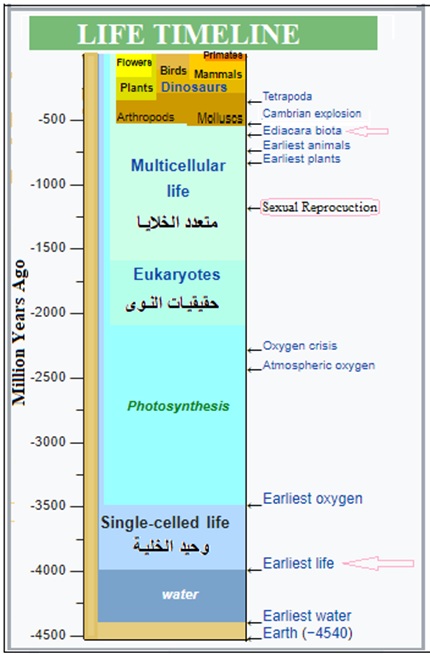
{And we have created man …} That is, we planned and determined what will reach in its end a human being, {from a lineage [descendant] from clay …} That is, it comes from a lineage or a chain of which the first stage of it is from clay. We know from our modern science, the first living cell was formed by a chemical process from the substances found in nature, clay and air, this cell was simple, primitive with the ability to divide, that is, it makes a second cell like it, see the Almighty saying: {He created you from one Nafs [living cell] and thereafter made from it its pair} Thus, these cells multiplied by division, and had no nuclei, it had an outer wall that enclosed a self-replicating RNA (later it became DNA). Bacteria are single-celled organisms of the same prokaryotic type as well as blue-green algae. This cell was found more than 3.5 billion years ago.
The step that followed the prokaryotic cell is the eukaryotic cell, distinguished from the first by that the DNA resides in a nucleus with a strong double wall that protects the nucleus, and protect in it the DNA.
If life is defined as the mechanism of reproduction, then the DNA is this mechanism, and the cell provides two important functions, first it provides protection for the very weak genetic chain (DNA), and secondly provide the suitable place for it to complete the complex biological evolution processes.
The verse said:
{Thereafter We made him into Nutfah in a strong resting-place (13)}
The verse indicates that Al Nutfah which is a little water which denotes the cell, in it the DNA was placed in a strong deep place, the place is the eukaryotic cell nucleus with its strong double wall, the appearance of the Eukaryotes around 2.0 billion years ago, marked a very important milestone in the evolution of life. (Eukaryotes single cell organisms are algae, amoeba and many other mostly microscopic organisms such as bacteria)
{ ثُمَّ خَلَقْنَا النُّطْفَةَ عَلَقَةً فَخَلَقْنَا الْعَلَقَةَ مُضْغَةً فَخَلَقْنَا الْمُضْغَةَ عِظَامًا فَكَسَوْنَا الْعِظَامَ لَحْمًا….}
{Thereafter We created al Nutfah into Alakah ……}
Then the Nutfah which already had a strong walled protected nuclei, this Nutfah was made into Al Alakah, Alakah in Arabic means something hanging to another, two or more things clinging together, which points to the multicellular organisms, which appeared around 1.5 billion years ago, when two or more of the single cells attached to each other, this was very important milestone in the evolution chain.
The first thing that appeared from the Alakah or the multi cellular organisms is the worms, sponges, and jellyfish.
{..Then We created the Alakah into tissue, then We created the tissue into bones, then We dressed the bones in flesh ;….}
Then the tissue evolved from the Alaka, the tissue is the primitive invertebrate animals.
Then the tissues was created into bones around 600 million years ago, which are the organisms that has an external hard shield such as snails, oysters, mussels and other mollusks. Also the small shelly fauna early skeletal fossils and Cloudinidae were among the earliest animals known to have grown hard, mineralized exoskeletons, which lives during the Ediacaran period.
Then the bones were dressed in flesh which are the vertebras, marine and land animals, when the warm blooded mammals appeared around 540 million years at the Cambrian explosion, after that, and during the past 500 million years, evolved and branched into millions of species, and from one of them came the human Insan.
{thereafter We developed him into another creation},
Thereafter, God evolved Al Insan into new species Al Bashar [the Homo sapiens].
This verses 12, 13 and 14 of Surah 23 described the general outline the main stages of the life evolution from the first cell till the Homo sapiens, us.
To Be Continued in the Next Episode.
Click on the following title to view this video on the YouTube channel: